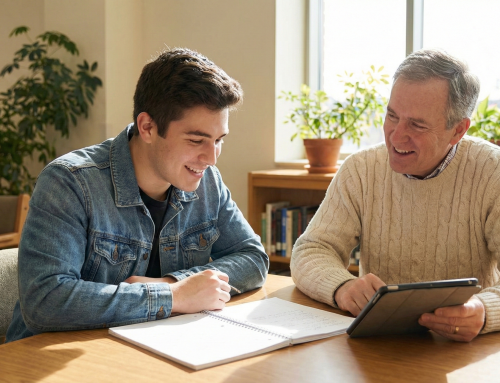
Neighborhoods carry enormous potential to serve as hubs of support, safety, and shared growth for everyone who calls them home. If you want a safer, more connected community, consider Tellegacy. The program creates opportunities for young people to build meaningful ties with older generations while also strengthening the bonds between neighbors themselves. These intergenerational conversations often grow into trusted relationships, networks of care, and shared resources that benefit the entire neighborhood, turning once-fragmented blocks into vibrant communities where people look out for one another.
Let’s take neighborhoods near college campuses, for example.
College campuses often represent vibrant hubs of youth, learning, and possibility. Yet just beyond the campus borders, neighborhoods frequently include older residents who have lived in the community for decades. While this coexistence can fuel growth, it sometimes results in tension—noise complaints, parking issues, or perceived lifestyle differences. These tensions, if left unaddressed, can create distance between groups who might otherwise enrich one another’s lives.
The Tellegacy Program offers a proactive solution: inviting student organizations to adopt structured intergenerational initiatives that connect students and neighborhood residents. These programs transform potential points of conflict into opportunities for collaboration, dialogue, and mutual respect.
Intergenerational Programs as a Bridge
Research consistently highlights the benefits of intergenerational engagement for both students and older adults. For students, opportunities to interact with older adults in authentic ways promote empathy, active listening skills, and resilience—qualities that extend into academic and professional success (Burns et al., 2022). For older residents, engaging with students helps reduce loneliness and social isolation, both of which are linked to physical and mental health risks (Cudjoe et al., 2020).
Tellegacy’s model emphasizes story-sharing, reflective dialogue, and relationship building. When these activities are centered around student-resident partnerships in college neighborhoods, they can help reshape the very culture of the surrounding community.
Improved Outcomes for Neighborhoods
The ripple effects of these interactions are significant:
- Community Safety: Research demonstrates that when neighbors trust and know one another, they are more likely to intervene during emergencies and look out for each other (Sampson, 2012). Programs like Tellegacy strengthen these bonds of trust, thereby improving neighborhood safety.
- Mutual Support: College students often face stress, anxiety, and uncertainty, while older adults may experience loneliness or declining social networks. Bringing these groups together creates natural support systems where encouragement, advice, and practical help flow in both directions.
- University-Community Relations: Alumni who live near campuses often feel deeply tied to the institution. Tellegacy provides a framework for these alumni to reconnect with current students, reinforcing loyalty to the university while providing mentorship that only lived experience can supply.
- Cultural Growth: When students hear stories of resilience, career pathways, or the social history of their city from older residents, they gain context for their own journey. These interactions transform neighborhoods into living classrooms.
Wisdom Shared, Futures Strengthened
The beauty of Tellegacy’s approach lies in the reciprocity of the exchange. Students benefit from mentorship, career advice, and the wisdom of navigating life’s challenges. Older residents experience renewed energy, purpose, and pride as they invest in the younger generation. Together, they form intergenerational teams capable of enhancing neighborhood vitality.
This is not merely a “feel good” program—it is a strategy for building resilient, inclusive, and safe communities that can last for decades. As Putnam (2020) argues, social capital, the networks of trust and reciprocity between individuals—is a key determinant of community health. Tellegacy helps generate exactly this capital in neighborhoods where it matters most.
Conclusion
The presence of college campuses in residential neighborhoods does not need to be a source of division. By leveraging the Tellegacy Program, student organizations can take the lead in empowering social longevity and neighborhood safety. In doing so, students and residents alike create relationships that not only enhance their present lives but also contribute to a culture of mutual care and support for years to come.
When people love and trust those in their neighborhood, they are more likely to act in ways that protect and uplift one another. In this sense, intergenerational connection is more than a social benefit—it is a public safety measure, a wellness intervention, and a legacy worth building.
For more information, visit/contact the following…
Site: www.tellegacy.org
Email: social@tellegacy.com
References
Burns, V. F., Pollock, K., & Mutchler, J. E. (2022). Intergenerational programs: Promoting community engagement and well-being. Journal of Intergenerational Relationships, 20(1), 1–14. https://doi.org/10.1080/15350770.2021.2006374
Cudjoe, T. K., Kotwal, A. A., & Sharifian, N. (2020). Loneliness and social isolation in older adults: A global public health crisis. Public Policy & Aging Report, 30(4), 138–143. https://doi.org/10.1093/ppar/praa023
Putnam, R. D. (2020). The upswing: How America came together a century ago and how we can do it again. Simon & Schuster.
Sampson, R. J. (2012). Great American city: Chicago and the enduring neighborhood effect. University of Chicago Press.