Accountability Is Community
Accountability gets a bad reputation.
Many people hear the word and think of correction, pressure, judgment, or someone watching for mistakes. But the healthiest form of accountability is much warmer than that.
Accountability is what happens when people care enough to help each other stay connected to what matters.
In a strong community, accountability is not punishment. It is care with structure. It is love with boundaries. It is encouragement with follow-through.
This is why accountability and boundaries belong together. Boundaries tell us what protects the relationship. Accountability helps us live up to the relationship.
Both are key ingredients for community.
Community Helps Us Live Out What Matters
Living out “what matters” starts with knowing who we are, what we value, and who helps us stay grounded.
Most people do not become their best selves in isolation. We become more fully ourselves through trusted relationships, honest conversations, shared routines, and people who remind us of our purpose when life gets heavy.
Community gives us a place to practice who we say we want to be.
It helps us keep showing up. It helps us return to our values. It helps us notice when we are drifting away from our health, our purpose, our relationships, or our peace.
This kind of accountability is a gift.
It says, “I see who you are becoming, and I care enough to help you stay close to that.”
Staying Connected Is a Health Strategy
Research continues to show that strong social connection is tied to longer, healthier lives.
A major meta-analysis found that people with stronger social relationships had a 50% greater likelihood of survival compared with people with weaker social relationships (Holt-Lunstad, Smith, & Layton, 2010). Later research found that loneliness and social isolation are both associated with increased risk of premature mortality (Holt-Lunstad et al., 2015).
The U.S. Surgeon General has described loneliness and isolation as a serious public health concern, noting that loneliness and social isolation are associated with increased risk for premature death, heart disease, stroke, anxiety, depression, and dementia (Office of the U.S. Surgeon General, 2023).
The CDC also identifies social connection as protective for serious health concerns, including heart disease, stroke, dementia, depression, and anxiety (Centers for Disease Control and Prevention, 2024).
This matters because community is often treated like a nice extra.
It is not an extra.
Community is part of how the body experiences safety, rhythm, meaning, and support.
Connection Supports the Heart
The heart does not live separate from our relationships.
When people feel supported, heard, and emotionally safe, the body often has a better chance to regulate stress. Strong social ties are associated with healthier cardiovascular outcomes, while loneliness and social isolation are linked with increased risk for heart disease and stroke.
The American Heart Association reported that social isolation and loneliness are associated with a 29% increased risk of heart attack or death from coronary heart disease and a 32% increased risk of stroke (American Heart Association, 2022).
This is what makes us pause.
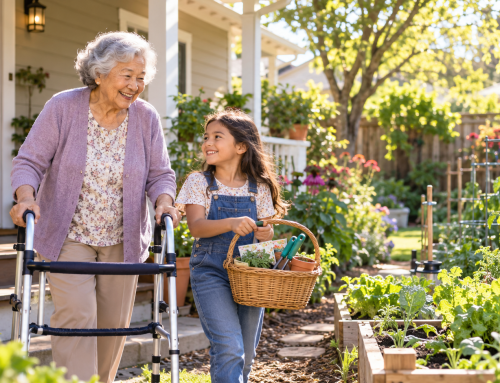
A phone call, a walk with a friend, a weekly meal, a church group, a student visiting an older adult, a neighbor checking in, a support group, a writing circle, or a regular coffee with someone who cares may seem small.
But small connections repeated over time can become a protective rhythm.
Connection Protects the Mind
Social connection also supports mental health and cognitive well-being.
The CDC notes that loneliness and social isolation can increase risk for depression, anxiety, dementia, and earlier death (Centers for Disease Control and Prevention, 2024). The National Institute on Aging also links loneliness and social isolation with higher risks for heart disease, depression, and cognitive decline (National Institute on Aging, 2024).
This makes sense at a human level.
Conversation activates memory. Friendship supports emotional regulation. Shared activities create routine. Being known gives people a reason to stay engaged.
When we stay connected, we give the mind more chances to participate in life.
Boundaries Make Community Healthier
Community does not mean saying yes to everything.
Healthy community needs boundaries.
Boundaries help us protect time, energy, values, responsibilities, and emotional safety. Mayo Clinic Health System describes boundaries as part of healthy relationships because they clarify the “rules of engagement” that help people relate to one another in healthier ways (Mayo Clinic Health System, 2023).
This is where accountability becomes powerful.
A boundary says, “This is what helps me stay well.”
Accountability says, “I will honor that, and I will help you honor it too.”
A healthy friend does not pressure you to betray your values.
A healthy colleague does not expect endless availability.
A healthy family member does not require you to abandon your peace to prove your love.
A healthy community helps people stay connected without being disconnected
Warm Accountability Helps People Become Their Best Selves
People who care for others hold them warmly accountable.
Accountable to what?
To being their best for their faith, themselves and for others.
That does not mean being perfect. It does not mean performing for approval. It does not mean living according to someone else’s expectations.
It means becoming more authentically, uniquely, and genuinely human.
When people are supported in becoming who they are called to be, the whole community benefits.
A healthier person becomes a steadier parent, friend, neighbor, caregiver, teacher, leader, volunteer, colleague, and citizen.
That is the beauty of community.
Personal growth does not stay personal. It spills outward.
How to Stay Connected in Real Life
Connection does not have to be complicated.
Start with small, repeatable actions.
- Choose one weekly connection ritual
Pick one action you can repeat every week.
Call a friend every Sunday. Walk with a neighbor every Wednesday. Send a voice memo every Friday. Attend one group, class, faith gathering, volunteer opportunity, or community event every week.
Consistency matters more than intensity.
- Deepen one casual relationship
Many meaningful relationships begin as casual interactions.
Invite someone to coffee. Ask a neighbor how they are really doing. Follow up with the person you met at an event. Send the message you keep meaning to send.
Connection often grows when one person takes the small risk first.
- Ask better questions
Move beyond “How are you?” when the relationship allows it.
Try:
“What has been giving you energy lately?”
“What has been heavy this week?”
“What are you looking forward to?”
“What would support look like right now?”
“What is one thing that matters to you in this season?”
Better questions create better connection.
- Practice small vulnerability
You do not have to share everything.
Start small.
Say, “That has been on my mind too.”
Say, “I have been trying to be more intentional about staying connected.”
Say, “I could use some encouragement this week.”
Small honesty gives others permission to be human too.
- Set one boundary that protects connection
Boundaries are not walls when they are used well.
They are doorways with wisdom.
A boundary might sound like:
“I want to stay connected, but I cannot text late at night.”
“I care about this conversation, and I want to talk when I can be fully present.”
“I need rest today, but let’s plan a time this week.”
“I want to support you, but I cannot be the only support.”
Healthy boundaries protect relationships from resentment, burnout, and confusion.
- Join something with a shared purpose
Purpose makes connection easier.
Volunteer. Join a class. Attend a local event. Participate in a walking group. Visit an older adult. Mentor a student. Join a book club. Serve with a community organization.
Shared purpose gives people a reason to keep showing up.
- Be the person who follows up
Community is often built through follow-up.
Send the article. Check on the appointment. Remember the birthday. Ask how the interview went. Circle back after a hard conversation.
Follow-up tells people, “You were not just a moment to me. You matter beyond that moment.”
Accountability Is How Community Keeps Its Promise
Community is not just being around people.
Community is what happens when people help one another live with care, truth, purpose, and responsibility.
Accountability keeps community from becoming passive.
Boundaries keep community from becoming unhealthy.
Connection keeps community from becoming lonely.
Together, they create something deeply human: a life where people are known, supported, challenged, protected, and invited to become who they are meant to be.
Longevity begins here.
Not simply with more years, but with more meaningful years.
Years with people.
Years with purpose.
Years with connection.
Years lived close to what matters.
Call to Action
This week, choose one person and one small action.
Send the text. Make the call. schedule the coffee. Join the group. Apologize. Set the boundary. Follow up.
Community does not begin with a crowd.
Sometimes it begins with one brave act of connection.
References
American Heart Association. (2022). Social isolation, loneliness can damage heart and brain health, report says.
Centers for Disease Control and Prevention. (2024). Social connection.
Centers for Disease Control and Prevention. (2024). Health effects of social isolation and loneliness.
Harvard T.H. Chan School of Public Health. (2024). Loneliness is hurting our health, but these policies could help.
Holt-Lunstad, J., Smith, T. B., Baker, M., Harris, T., & Stephenson, D. (2015). Loneliness and social isolation as risk factors for mortality: A meta-analytic review. Perspectives on Psychological Science.
Holt-Lunstad, J., Smith, T. B., & Layton, J. B. (2010). Social relationships and mortality risk: A meta-analytic review. PLOS Medicine.
Mayo Clinic Health System. (2023). Map it out: Setting boundaries for your well-being.
National Academies of Sciences, Engineering, and Medicine. (2020). Social isolation and loneliness in older adults: Opportunities for the health care system.
National Institute on Aging. (2024). Loneliness and social isolation: Tips for staying connected.
Office of the U.S. Surgeon General. (2023). Our epidemic of loneliness and isolation: The U.S. Surgeon General’s advisory on the healing effects of social connection and community.